
The status that took a week now takes one question
Ask the Executive Advisor whether you are on track, in plain language. It answers in seconds, across every team the question touches, with the next move attached and every claim traceable.
You can ask the Executive Advisor whether you are on track, in plain language, and get an answer that holds up, with the next move attached. The same answer used to be a week of work: emails to five owners, a status deck someone assembled, numbers already stale by the time the meeting started. Now it is one conversation.
Ask the question you used to assemble by hand
Take whatever you are accountable for this quarter and ask whether it is on track. In this walkthrough it is a margin commitment to the board; yours might be a product launch, a system migration, or a regional target.
The first answer crosses every team the question touches: cost-to-serve sits with Customer Operations, the platform slip with Engineering, the basis points with Finance. Nobody assembled it for you, and it is specific enough to act on and specific enough to challenge.
The answer ends in a move
Ask what to do about it, and it comes back with one: escalate to the operating committee this week, get Customer Operations and Engineering in the same room, and if the platform ships by month end, Q4 holds. A recommendation you can act on or push back on; the call stays yours.
No dashboard holds that answer, because no other single system knows that the margin commitment, the platform slip, and the two teams involved belong to the same question.
When something changes mid-quarter
This is where the Executive Advisor is strongest. You are executing, and something moves: a launch slips, a dependency breaks, or the market shifts under a bet you made. Ask what changed and what it means, and it analyzes the situation across everything connected to it: which strategic choices the change touches, whose commitments it puts at risk, what it does to the numbers you are accountable for, and what to do next. The walkthrough above is exactly that case: a three-week platform slip, turned into what it costs the quarter (roughly 60 basis points of Q4 EBITDA) and a suggested move with a deadline on it. The change surfaces as an analyzed impact while there is still time to act, not as a surprise in the quarterly review.
You can trust it, because you can trace it
The answer is traced through the graph your teams maintain: the strategic choice, the objectives under it, the teams that own them, and the dependency putting the quarter at risk. You can see who declared each piece, so you can check the reasoning before you bring it to a check-in, a review, or the board.
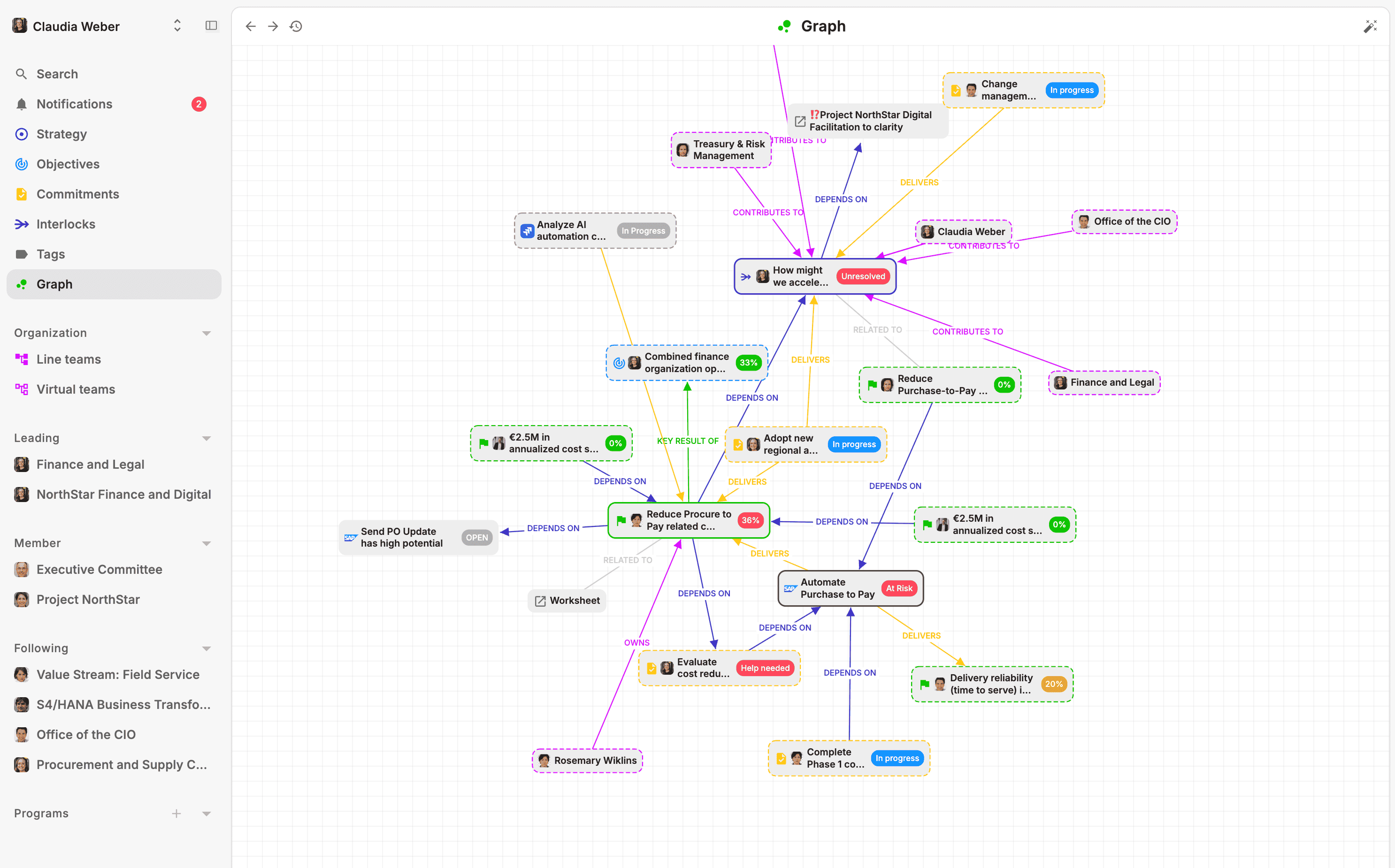
Ask anything cross-functional
The same holds for the questions you carry into every review:
- "What needs my attention this week?" returns a short list ranked by what is at risk, each item with the owner to talk to.
- "Where should we reallocate budget next quarter?" shows which teams are ahead, which are blocked, and what moving money would unblock.
- "Which strategic choices have nothing executing behind them?" lists the gaps choice by choice, with who owns each one.
- "Are we on track to deliver the Nordic expansion this quarter?" comes back in the same shape as the margin answer: where it stands, what is slipping, and the move.
What it changes
Status stops being something your organization produces and becomes something you ask. The work your teams already do is the answer: you read it, decide, and move, with the whole cross-functional picture in front of you.
The Executive Advisor is part of Tangible Growth. To see it answer on your own strategy, book a demo.
