
Upload the deck. Get back a strategy teams can build against.
Your strategy documents come back as choices someone owns, with the work connected to each one and a suggested Game Plan available to every team.
Tangible Growth takes your strategy and turns it into choices: each one owned by a person, connected to the work that delivers it, and ready for every team to build their own plan on. The old way is familiar: the strategy is presented in January, every team translates the deck by hand, one strategy becomes three readings of it, and the file is not opened again until the review. Now the deck is where the strategy starts, not where it lives.
It reads your strategy and drafts the choices
Upload your strategy documents. Tangible Growth reads them and lays them out as choices, structured on the Playing to Win framework (Lafley and Roger Martin): where you play, how you win, what it takes. One of yours might come out as "defend and grow in DACH." It drafts each choice and you refine it. Where the documents don't actually say something, it leaves the gap for you rather than inventing an answer.
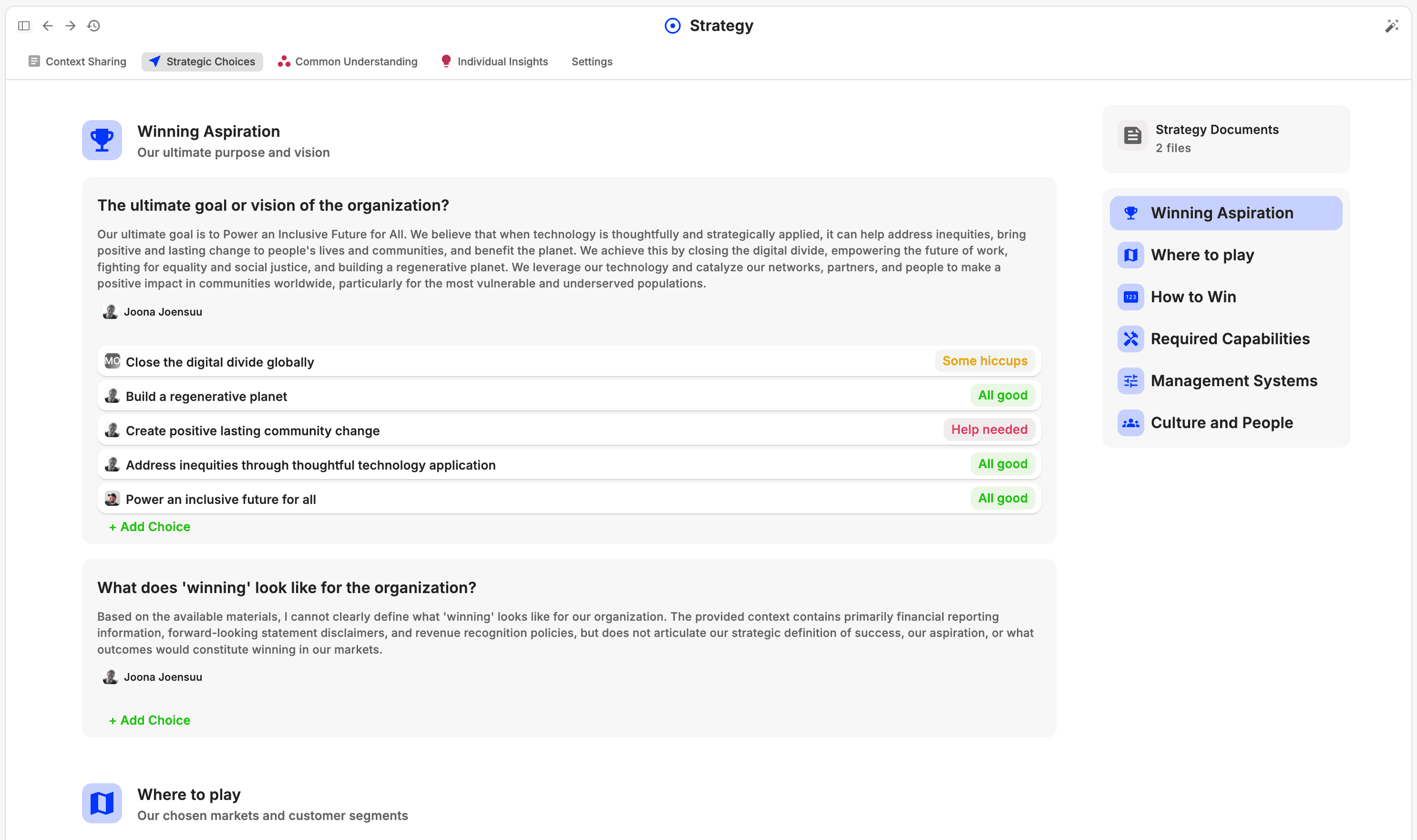
Each choice is a real object someone owns
"Defend and grow in DACH" now carries an owner, a confidence you can read at a glance, a validity window, and tags. It stopped being slide 14 of the deck; it is something a named person stands behind.
The confidence is worth being precise about: it is declared by the owner, not computed from a rollup, and you can see when it was last updated. "At risk" on a choice means the person who owns it said so. That is a different artifact from a dashboard turning amber, and it is the reason the status can be trusted in a board conversation.
The work connects to the choice
Link the objectives, commitments, and KPIs that deliver a choice to it. Open "defend and grow in DACH" and the work behind it is right there: what is in flight, and how each piece is doing. The connection is recorded as people link the work, so it stays current instead of being reconstructed for the next review.
The reverse is just as visible. A choice with nothing linked to it shows that plainly, choice by choice, so the gap between what you decided and what is actually happening surfaces now instead of in the Q3 review.
The same connection carries changes back out. When a choice shifts in June, you edit the choice: the validity window moves, and every team whose plan is built on it sees the change where they work, because the link already exists. The alternative is the one you know, a revised deck and a re-cascade roadshow.
Teams start from the strategy, not a blank canvas
From the choices, each team can pull a suggested Game Plan: vision, methods, what the team will not do, the OKRs, all grounded in the strategy you set. The team delivering DACH puts the suggestion beside their current plan, takes what fits, and changes what does not. The plan stays theirs. What the suggestion changes is the starting point: every team begins from the same choices, so one strategy stays one strategy.
What it changes
Teams work from plans grounded in named choices, so it is clear which bets the work delivers and why it matters. Leaders read the strategy off the choices and the work linked to them, not a deck reconstructed for the meeting. You make the calls and own them; Tangible Growth keeps the strategy and the work in one place.
And the structure compounds. The choices, owners, and links your teams declare are the graph the Executive Advisor answers through: when you ask whether you are on track next quarter, the answer is traced through exactly what you built here.
Strategic choices are part of Tangible Growth. To see your own strategy come back as choices, book a demo.
